
With 2017 firmly in the rear-view, it’s time to take stock of recent and anticipated bid protest developments. Today, we’ll look back and highlight five of the most significant trends in 2017 bid protests. In the near future, we’ll turn our gaze forward and predict the five most important protest developments to keep an eye on in 2018.
Continue Reading Top Five Bid Protest Topics in 2017

All Things Protest: The Inaugural Podcast
Crowell & Moring’s “All Things Protest” podcast keeps you up to date on major trends in bid protest litigation, key developments in high-profile cases, and best practices in state and federal procurement. In this inaugural episode, hosts Olivia Lynch, Rob Sneckenberg, and Christian Curran cover GAO’s FY2017 bid protest statistics, the RAND Corp.’s comprehensive report
When is a Required Evaluation Not Required? A Warning for Contractors Expecting the Government to Evaluate Professional Compensation
Everyone can agree that professional employees should be compensated fairly and properly—both for the benefit of the employees and to ensure successful contract performance. However, a recent GAO decision could provide a loophole for agencies to forego the very evaluation designed to ensure that fair and proper compensation.
Contractors competing for work involving meaningful numbers of professional employees—and, in particular, incumbents seeking to prevent newcomers from undercutting their established professional compensation—should take note.Continue Reading When is a Required Evaluation Not Required? A Warning for Contractors Expecting the Government to Evaluate Professional Compensation
Sustains on the Rise in FY 2016: The Key Takeaways from GAO’s Annual Report to Congress
On December 15, 2016, GAO released its Annual Report to Congress for Fiscal Year 2016, including its updated Bid Protest Statistics for Fiscal Years 2012-2016. The Report, which GAO is required to submit pursuant to the Competition in Contracting Act of 1984, 31 U.S.C. § 3554(e)(2), identifies the most common reasons for sustained protests in FY 2016: (1) unreasonable technical evaluation; (2) unreasonable past performance evaluation; (3) unreasonable cost or price evaluation; and (4) flawed selection decision. And, oh boy, were there a lot of sustains.
The full statistics, copied below, reveal that GAO sustained nearly as many protests in FY 2016 (139) as it did in FYs 2015 and 2014 combined (140). Interestingly, however, the overall “effectiveness rate”—i.e., the percentage of cases in which the protester received some form of relief—ticked up only one percentage point from FY 2015 (from 45% to 46%). The increased percentage of sustained protests, combined with the similar (though steadily increasing) effectiveness rate, means that agencies took corrective action in far fewer meritorious protests. That’s a bit surprising given that, anecdotally at least, corrective action is still a common outcome in response to strong protest filings. It will be worth watching whether this was just a one year exception, or if we’ve now passed the high-water mark for corrective action seen in FYs 2014 and 2015.Continue Reading Sustains on the Rise in FY 2016: The Key Takeaways from GAO’s Annual Report to Congress
C&M Lawyers Conduct Live Webinar on OCIs and PCIs on Wednesday, May 11th
On Wednesday, May 11th, 2016 at 1 PM Eastern, join our Crowell & Moring attorneys for a webinar entitled: “Organizational and Personal Conflicts of Interest: New and Pending Rules.” During this 90-minute webinar, our experts will clarify key principles, including a review of 2014 proposed amendments to the 2011 FAR conflict of interest rules. From
Hiring a Former Government Official? Obtain and Hold On to the Ethics Letter
The Department of Defense (DoD) Office of Inspector General (IG) recently released a July 6, 2015 Memorandum announcing that it will “immediately” begin the field work for its assessment of DoD compliance with Section 847 of the 2008 National Defense Authorization Act (NDAA), “Requirements for Senior Defense Officials Seeking Employment with Defense Contractors.” Section 847
Federal Circuit Requires Government to Indemnify Contractors for CERCLA Remediation Costs Based on “Taxes” Provision in WWII Contracts
Last month, the Federal Circuit decided a case over 70 years in the making. Following the bombing of Pearl Harbor in 1941 and full-scale U.S. entrance into World War II, the government entered into a series of contracts with oil companies to ramp up production of aviation gasoline (“avgas”) desperately needed for the war effort. But along with increased production came increased waste and toxic byproducts, notably spent alkylation acid and “acid sludge.” Safe waste disposal could not keep up with production, and much of the waste was eventually dumped at a site in Fullerton, California.
Until last week, the oil companies were on the hook for the cleanup costs. Thanks to the Federal Circuit’s recent ruling, though, the government must now reimburse the contractors for their remediation costs. The discussion below traces the course of the litigation, outlines the Federal Circuit’s legal analysis, and discusses how the decision represents but one potential avenue for U.S. government contractors to recover environmental remediation costs.
Continue Reading Federal Circuit Requires Government to Indemnify Contractors for CERCLA Remediation Costs Based on “Taxes” Provision in WWII Contracts
Negotiating False Claims Act Settlements
A prominent FCA practitioner observed twenty years ago that while FCA settlements were common, it was impossible to find a standard settlement agreement, if there was such a thing, or a DOJ policy on point.¹ His words ring true today. While the FCA has become the Government’s principal anti-fraud weapon, little has been written about
GAO Releases Protest Statistics for FY 2013
In its annual report to Congress under the Competition in Contracting Act of 1984, 31 U.S.C. § 3554(e)(2), GAO disclosed the following bid protest statistics for FYs 2009-2013:
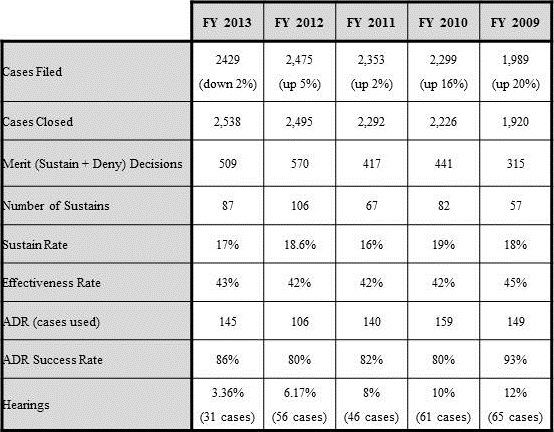
For the first time since FY 2006, the number of cases filed in FY 2013 decreased from the previous year (the FY 2005 – FY 2009 statistics, and C&M’s analysis thereof, are available here). However, it’s too early to tell whether the 2% downturn in protests filed was an anomaly, a result of sequestration (including furloughs of personnel with acquisition responsibilities) or impending government shutdown, or simply an inevitable leveling-off after multiple record years of protest filings.
Continue Reading GAO Releases Protest Statistics for FY 2013
C&M GC Chair and Former OFPP Administrator Participates in Televised Panel on Improving Communication and Transparency Between Government and Industry
This Sunday, September 22, 2013, join Angela Styles, chair of Crowell & Moring’s Government Contracts Group, as she discusses highlights from the 2013 National Contract Management Association (NCMA) World Congress Past OFPP Administrators Panel. Angela, along with NCMA Fellow Robert Burton, will appear on Government Contracting Weekly to share lessons learned and insights on